Showing posts with label Hiking. Show all posts

Thursday, February 4, 2016

Starved Rock State Park: Frozen Waterfalls and Bald Eagles

On Tuesday the groundhog (both Woodstock Willy and Punxsutawney Phil) predicted the onset of an early spring. While this means better weather for most things outdoors, it also means I needed to make it a priority to get down to Starved Rock State Park to see the last bit of ice on the waterfalls. My sister had the day off so we headed south for a day hike through some of the state's most beautiful bluffs and canyons.

Located approximately 90 miles southwest of Chicago in Utica, Illinois, Starved Rock State Park gets its name from Starved Rock, a bluff along the south side of the Illinois River. According to legend, in the 18th century a group of Illinois Indians starved to death on the bluff after being besieged by Potawatomi and Fox warriors.The state park, which was founded in 1911, is one of the most beautiful places in Illinois and features beautiful geology, excellent hiking, and scenic views of the Illinois River. Starved Rock is most famous for its sandstone canyons and waterfalls, which were formed over the course of thousands of years of erosion of St. Peter Sandstone during an event called the Kankakee Torrent (17,000-14,000 years ago).

We arrived at Starved Rock in the late morning and parked at the visitors center on the very western edge of the park, where we began our hike. We started on the bluff trail and headed into French Canyon (paying homage to Louis Joliet, Fr. Jacques Marquette, and other French explorers who first came to the area over 300 years ago), which contained a beautiful frozen waterfall. Much of the trail involved hiking on top of a boardwalk, which was installed to protect the highly susceptible soil and rock from erosion. We continued to Wildcat Canyon, which had a much larger frozen waterfall.


French Canyon
 

Wildcat Canyon


After passing Sandstone Point Overlook we descended a big set of stairs and arrived at the river trail. We continued east through Lonetree Canyon along the trail as it followed the shoreline of the Illinois River. Hiking along the river allowed us to see another feature that makes Starved Rock such a cool place: its population of Bald Eagles. Bald Eagles spend the winter along the Illinois River, peaking in number in January/February before migrating back north to breed in the summer. Although I wasn't able to get any good pictures of them, we saw 8 Bald Eagles over the course of our hike.


Descending the stairs to the River Trail
 

Two Bald Eagles perched on the Illinois River

After reaching the river trail the boardwalks ended and the trail turned to dirt, which got a little muddy (good hiking shoes are recommended). The trail turned away from the shore of the river and we hiked into La Salle Canyon (Tonty Canyon was closed due to a defunct bridge). The 1/3 mile side hike into La Salle Canyon terminated at a beautiful waterfall, which was in full flow due to recent rain. After spending some time playing with some long exposure photography at the waterfall (I wish I'd brought a tripod) we made our way back to the river trail.
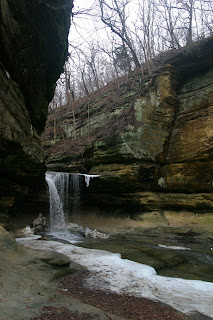
 

La Salle Canyon Falls


After another short time alongside the river we climbed another set of stairs and found ourselves back atop the bluffs, which provided great views of the river below. We continued on the ridge winding inland around Hennepin Canyon and back out onto the bluffs along the river. We crossed Route 71 just before the turnout for Ottawa Canyon and Kaskaskia Canyon.


Looking down into Hennepin Canyon from the Bridge
We decided not to hike into Ottawa or Kaskaskia Canyon in the interest of time (we had been hiking for 3 and a half hours and only had 2 hours of daylight) so we continued on into Illinois Canyon and got halfway through the canyon before reaching a small creek. We opted not to cross so that we didn't have to hike all the way back to the car in cold wet boots but Illinois Canyon was very scenic and probably the widest and largest canyon of any that we had been in.
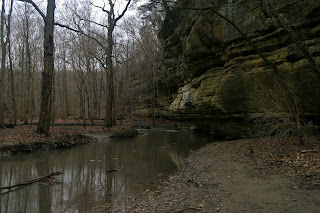

Illinois Canyon
 We made our way back to the car following the way we came until we got back past La Salle Canyon. From this point we changed it up a bit and took the river trail the entire way back instead of the bluff trail we had come out on. Along the way we spotted dozens of Downy Woodpeckers and other birds. From the river trail we got a great view of Eagle Cliff Overlook.

Downy Woodpecker
Eagle Cliff Overlook
We followed the trail to the top of Eagle Cliff Overlook (more stairs, yay!), which provided us with a beautiful view of the Illinois River, the Starved Rock Lock and Dam (which signs pointed out allowed more than 45 million tons of goods to pass through each year) and Starved Rock. We got back to the car just before sunset, 6 hours, 11 miles, and hundreds of stairs later.

The view from Eagle Cliff Overlook
Starved Rock Lock and Dam
Starved Rock
The Hike: Starved Rock State Park from Visitor's Center to Illinois Canyon via Bluff Trail and River Trail, 11 miles, 200 ft. elevation gain (done multiple times!)

Enjoy Starved Rock and Leave No Trace! Seriously though there was alot of garbage along the trail and it was kind of disappointing to see so many people being such pigs.

Thursday, January 21, 2016

Crabtree Nature Center: Phantom Prairie Loop

This past weekend I was also able to get out for a hike at the Crabtree Nature Center, a 1182 acre preserve operated by the Forest Preserve District of Cook County located in Barrington, IL. It felt good to be back there, I hadn't been since I was a kid visiting with scouts in grade school. It's kind of funny how I'm rediscovering all of this outdoor stuff back home in Illinois after so many years of taking it for granted. I have Arizona to thank for it! I hiked the Phantom Prairie Loop, a 2 mile hike through woodland and prairie. Being winter I had the trail almost completely to myself and the addition of snow on the trees made everything look really pretty. Along the way I saw a coyote and a few white-tailed deer, as well as dozens of birds at the bird feeders outside of the nature center building. The preserve is home to 89 species that breed on-site and during spring migration over 260 can be seen. As beautiful as the snow was I can't wait to go back and enjoy this hike in the summer when the wildflowers are blooming.


Black Capped Chickadee
Northern Cardinal and House Finch
White Breasted Nuthatch

American Goldfinch (Female)

The Hike: 2 miles, hardly any elevation change
Check out Crabtree Nature Center here: http://fpdcc.com/nature-centers/crabtree-nature-center/

Leave No Trace!


Sunday, January 17, 2016

Nachusa Grasslands: Bison Return to Illinois


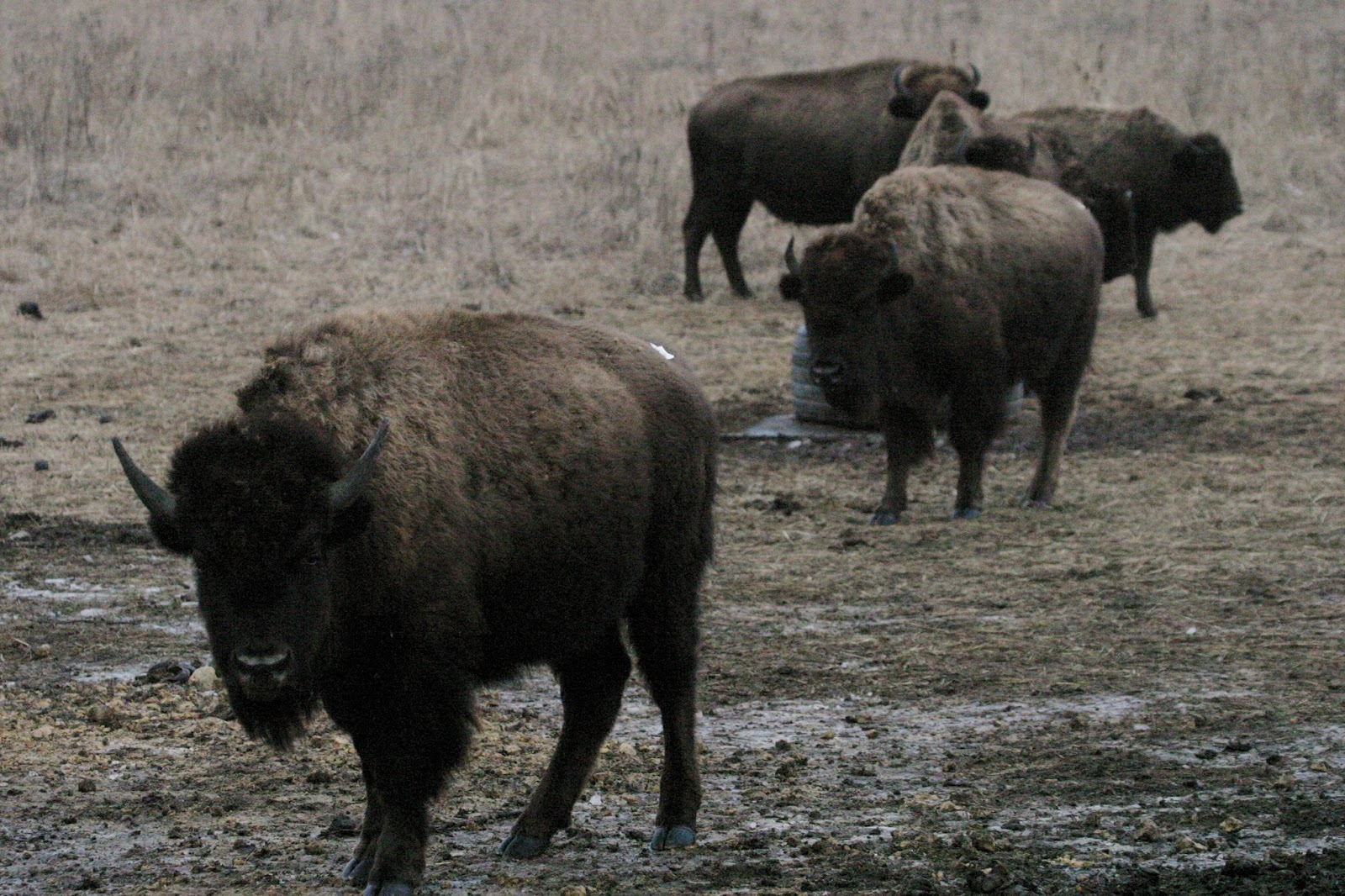
Bison were extirpated from Illinois in the 1830s. The population once numbered more than 50 million, spanning across North America from the Gulf of Mexico all the way up to Alaska. At 6 ft. tall and 2000 lbs, Bison are the largest land animal in North America, a remnant of the mega fauna that once roamed the continent thousands of years ago. However, by the end of the 19th century, their numbers dropped to only 1000 individuals (less than 100 of them free roaming), isolated in a few places in western states. Through vigorous conservation efforts Bison have been brought back from the brink of extinction yet for many of the states where they once roamed, they remain absent with the exception of some captive bred populations for meat. This changed in Illinois in October 2014 with the reintroduction of a herd of wild Bison at Nachusa Grasslands, a Nature Conservancy owned property in Franklin Grove, IL, 90 miles west of Chicago. 

Originating on 400 acres of land purchased in 1986, Nachusa Grasslands is a unique site that today protects approximately 3500 acres of restored tallgrass prairie that once covered much of the midwest. Tallgrass prairie, like Bison, suffered greatly at the expense of land development for agriculture as European settlers arrived in North America. In Illinois more than 99% of the original prairie was lost and converted to farmland. The Nature Conservancy, an environmental nonprofit, owns and operates the land and has worked to restore the site with more than 700 species of native prairie plants and more than 200 species of birds, mammals, reptiles, and amphibians. Thanks to the help of volunteers and staff, more than 100,000 hours of work have resulted in a beautiful nature preserve.


The idea for Bison reintroduction originated due to the many benefits that they provide to the prairie ecosystem. Bison grazing was a major force to promote growth and rejuvenation of the prairie, the impact of which was exceeded in magnitude only by wildfires and drought. Under their tremendous weight, depressions are carved out in the soil to create pools of water that provide breeding habitat for amphibians. Their hooves aerate and loosen topsoil while their coats transport and disperse seeds that stick to their dense fur.  Bison also help remove trees, which allows light to reach prairie grasses and shrubs that require full sun.


Beginning with 20 individuals transported from Wind Cave National Park in South Dakota as well as other Nature Conservancy Sites (this isn't their first time reintroducing bison), the herd arrived in October 2014 and currently roam more than 1500 acres. The population is unique in that it is descended from pure strains of Bison. Many of the captive bison that we see today in the meat industry are actually descended from "beefalo" hybrids between Bison and cattle.The herd at Nachusa has grown to around 50 individuals thanks to the birth of several calves. April 6th, 2015 marked the first wild Bison born east of the Mississippi River in nearly 200 years.


While no hiking is permitted within the Bison units (which are fenced off to keep the bison in and people out), visitors are encouraged to stop by and view the herd from outside the enclosure. The bison roam freely all year without human intervention in feeding, breeding, or survival, with the exception of one day of veterinary examination. I spent Friday afternoon hiking near the Bison Unit observing the herd. They were pretty close to the outer boundaries of the unit so I was able to get some decent pictures with a zoom lens. While the rolling hills of the preserve obstructed my view of farmhouses and other signs of civilization I watched the bison wander across the prairie and I began to imagine what Illinois looked like hundreds of years ago. In the year since the reintroduction the project has appeared pretty successful and a second herd has been established in Illinois at Midewin National Tallgrass Prairie near Joliet. It's exciting to see what will come of this incredible conservation project and I'm really happy to have Bison back in Illinois.


For more info on Nachusa Grasslands, the Bison, and volunteering check out: